These glass packaging buying guides start where most projects do — with the bottle. But a container, a closure that seals it and a box that survives a container load are sourced together, and the choice in one constrains the other two. Each guide below walks through a single decision, in the order a real project hits it.
Browse the guides below — or scroll down for how we handle sourcing end to end.
-
How to Request a Glass Bottle Quote: A Buyer’s Checklist
Most first quotes come back wrong, and it is almost never the supplier’s fault. A drawing with no capacity, a quantity that is actually a trial order, or a closure decision still open — any one of these turns an accurate quotation into a guess. This checklist covers what to send so the first reply…
What these glass packaging buying guides cover
These guides are written for brand owners and buyers who source bottles, jars, closures and boxes as one package, not four separate projects. Bottle shape, capacity and neck finish decide what closure will fit and how the filling line will run. Get the neck finish wrong and the whole project re-opens at the capping stage, long after the artwork is approved.
Closures: cork, screw cap or crown
A wine bottle and a spirits bottle rarely take the same closure. Cork, wood-top cork, screw cap, crown cap and glass stopper each change sealing performance, shelf presentation and the tooling you need. We compare them on sealing, cost and MOQ rather than on looks alone.
The box that carries the bottle
Rigid gift boxes, folding cartons and drawer boxes protect glass differently. Structure, inner lining — EVA, paper pulp or EPE — and print method drive both unit cost and MOQ. Buyers usually discover this late, after the bottle has already been approved.
Custom decoration and finishes
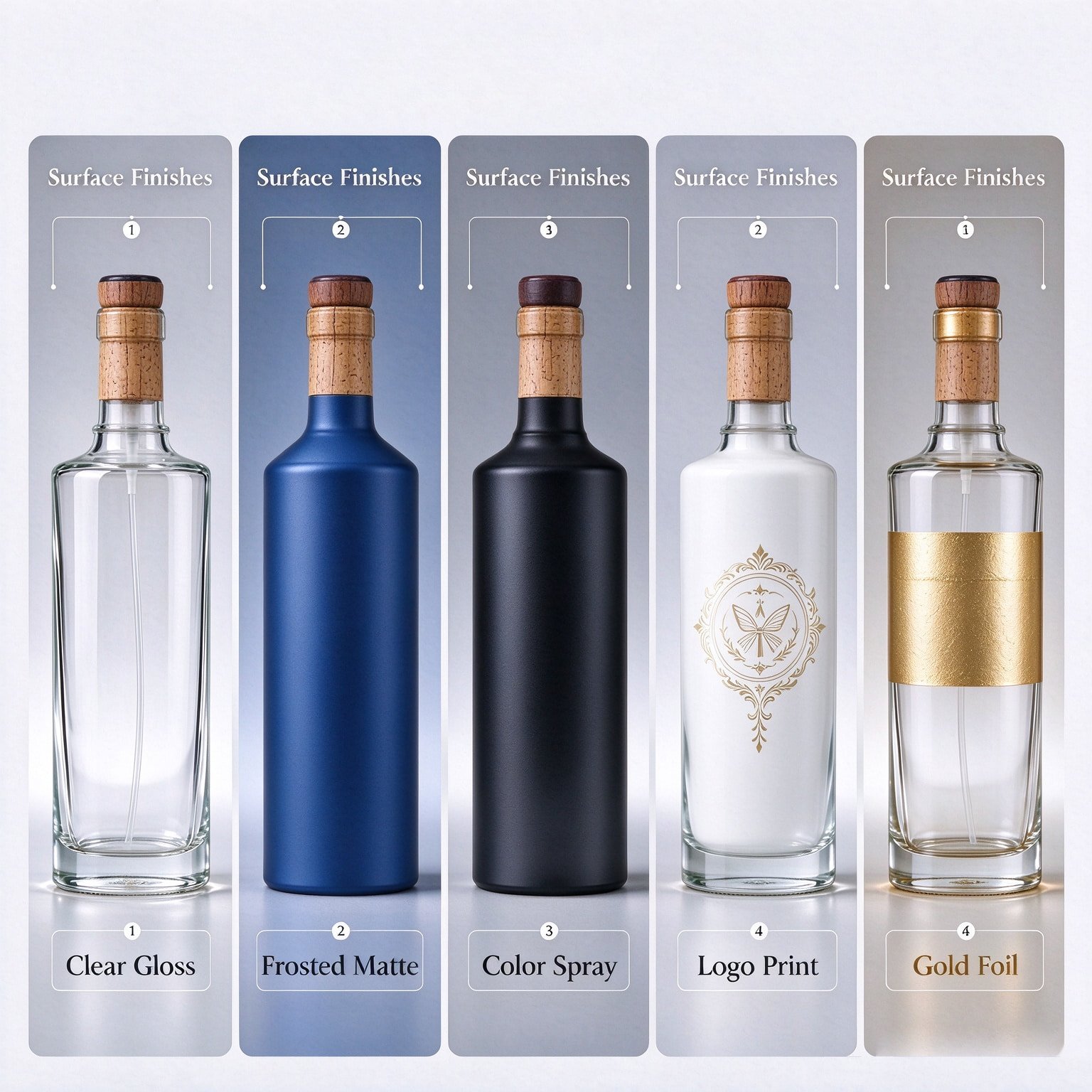
Frosting, coating, colour spraying, embossing and screen printing all sit on top of the base glass, and each carries its own MOQ and tooling implication. Which decoration works on which bottle type, and what each adds to unit cost, is covered guide by guide.
MOQ, tooling and lead time
This is where most quotes stall. MOQ depends on glass type — super flint starts lower than normal flint — and on whether a new mould is required. Tooling cost, sampling time and production lead time should be quoted together, not one at a time.
Food-contact compliance
FDA and LFGB requirements apply to the glass, the closure and any coating. Ask for test reports before the sampling stage, not after.
Why brands buy through a packaging supplier instead of a single factory
A glass factory makes bottles. It rarely makes closures, and almost never makes printed rigid boxes. That leaves four suppliers, four sets of tolerances and four lead times to coordinate. Most problems we see are not glass defects — they are mismatches at the joints: a neck finish that will not seat the cap, or a box lining cut for a bottle that grew two millimetres during sampling. Quoting the container, the closure and the box together closes that gap before it becomes a production issue.
Sampling and approval, step by step
Sampling is where projects are won or lost. We start from your drawing or physical sample, confirm capacity, neck finish and closure, then produce pre-production samples — typically 20 to 25 days. Approve on measurements, not photographs: measure the neck finish with calipers, check the cap torque, and confirm the box lining with the actual bottle inside it. Bulk production then runs 30 to 35 days from the approved sample. Skipping the measurement step is the most common reason a load gets rejected at the destination port.
Five mistakes we see every month
Choosing a bottle from a photo without checking its neck finish. Leaving the box until the end, then rebuilding the lining. Ignoring the MOQ attached to a decoration process. Treating a sample as a production standard. And asking for food-contact reports after the order is placed instead of before sampling. Each one adds weeks, and most of them add cost.
How to request a quote
Send us your drawing or sample, target capacity, estimated order quantity and destination country. We will reply with a tiered quotation covering the container, the closure and the box together, along with a realistic production schedule.
If you are not sure which guide applies to your project, send the brief and we will point you to the right one.